Slideshare

lunedì 7 dicembre 2015

What is Metadata and how is it used? [Infographic]

Digital marketers need to know the basics of metadata

Big Data created by interactions and transactions that the customers make online has been at the forefront of technology discussions over the last few years due to the huge increase in the amount of people online, from 15.7% (2005) to 45% (2015) as a percentage of the world’s population. But all that data is worthless if a business can’t manage it, and this is where Meta Data comes in. It is a concept important to the analysis of the large amounts of data, produced by the general public.

The documents leaked NSA analyst and whistleblower Edward Snowden in 2013, confirm that governments are actively seeking our metadata and because of outdated legal interpretation, Meta data is considered less sensitive than information even though it can be used to profile your whole life (and future).

We as a society are communicating via technology more and more. However, the content of our communications isn’t the only thing we send. Data about the communication allows it to reach its intended recipient. This is metadata.

The type of data that is recorded when accessing content or sending a message via email or a social media status update is as follows:

  • The type of device it was sent from, e.g. a computer, a telephone, a mobile
  • The location of the sender e.g. home address of the phone used, subscription information or the closest cell tower to the senders phone.
  • The time of day the message was sent
  • All the same information from the above three points would be recorded for the recipient of the message.
  • Other information about the communicators that doesn’t necessarily link to the communication e.g. their email address, address book entry information, email providers, IP address.
  • Also the length of the interaction or size of message e.g. Length of phone call or text message.

But that’s not all. When we use the internet, everything we do, what we type into Google, our search history, how long we spend online and the files we download are all recorded. Even when our phone is turned on, but not being used, it transmits its location which is then recorded.

What is metadata?

Literally, meta data can be defined as 'data describing other data'. It is a summary of the attributes or chacteristics of a type of data. In the example above it is data about an online interaction such as social media update or email message. Another non-transactionable example is the well known meta data about a web page such as its title and description which is read by search crawlers as a summary of what the page is like and presented in Google's results pages.

Metadata paints a picture about an individual’s daily routine, interactions, points of view and associations, and the reason it is so useful is that it doesn’t lie. The fact that such information is collected by internet companies shows how valuable it can be. Applying this capability across a population, it is possible to compile a very detailed, even invasive, picture population including their behaviours and interactions in which governments and companies can act upon.

what-is-metadata-and-how-is-it-used

Thanks to Take1 for publishing this infographic which prompted us to cover this definition of Meta data.


from Smart Insights http://ift.tt/1Izb5kX
via IFTTT

venerdì 4 dicembre 2015

24 Steps to a Start Up [Infographic]

The key to start-up success is planning and discipline

Starting a business is no mean feat, there are a vast number of factors which need to be considered and a successful business model needs imagination, insight and inspiration. Implementing the business model can be even harder than creating it, and needs determination and discipline. You need to be able to pay attention to the all the details and deliberate on the appropriate decision.

Alliteration aside, this infographic from Disciplinedentrepreneurship.com breaks down the processes of producing a successful start-up business model in 24 steps that will help you define your objectives and build your plan. Nothing is guaranteed in business, least of all in the fast-paced world of start-ups, but this infographic is almost certain to help you.

Click on the infographic to see an enlarged version

steps to startup


from Smart Insights http://ift.tt/1ItCtAQ
via IFTTT

A case study of a Black Friday retail campaign

An integrated small business campaign example

I awoke on the last Friday of November to the usual Black Friday hangover. On checking my emails I was inundated an avalanche of offers in relation to that American import which, like Halloween, is now huge over here in the UK too: Black Friday. With the Argos, Currys, Tesco and Boots' websites all experiencing outages due to weight of demand, the British public appears to have got over its aversion to this American celebratory holiday of all things consumer.

I run a niche ecommerce business that has a big US subscriber base, and based on previous Thanksgiving weekends it was clear that we needed to have a planned approach to the "holiday" season. As the day drew nearer we had customers emailing asking what we had planned as offers - it was going to be a big sales day.

Now we are a small business, our turnover isn't huge but we are the market leader in our sector worldwide. I have access to a designer and I run the website, email marketing and social media myself. I do also consult extensively in said fields (I wear a number of hats as well as running Musicademy) so I am also our in-house expert but the point here is that we're not working with a specialist agency. This is in-house DIY internet marketing so accessible to any marketer with a bit of digital savvy hence why I want to share what is quite a lengthy post with you.

What to offer on Black Friday?

The big retailers Asda (well they are owned by Walmart), Tesco, Amazon, John Lewis et al. all led with targeted big discounts including the aforementioned flat screen TVs. We have previously done spot sales on particular items but we've also tested blanket discounts across the entire webstore and have found average order value considerably higher as a result.

So we went for a 20% blanket discount off every product. With some of the existing sales and offers (we already reward bulk buyers) this represented a significant saving on RRP for many products.

Messaging

I like to think that people buy from people, not websites so we decided to go with a personal "With love and thanks from us to you" message which focussed on "Thanksgiving". We incorporated a "Thanks for subscribing to our updates" message and chose "THANKFUL" as our coupon code. We genuinely feel that way about our customers, and we also felt that this approach would go down well with our North American Christian market.

We have a sister company, Worship Backing Band, that targets a very similar audience so a similar campaign was also created for that.

Design

We stuck with a variant of the design style we've been evolving in recent months which reflects our corporate colours and other key elements. We have two image styles we tend to work with - one is a white silhouette of the different instruments we teach and the other is a series of pack shots. I wanted to use this campaign to test the effectiveness of each of these, and also to enable a variety of images across different platforms.

We tend to use a tinted image in the background of a lot of our ads so for these we chose some pumpkins - again reflecting the Thanksgiving occasion.

Choice of platform

In keeping with most ecommerce retailers email marketing is our normal workhorse channel so a Thanksgiving email duly made its way out at 8am on the morning of Black Friday to our 27,000 subscribers.

We also booked in third party emails with two partner organisations. One a big magazine which we've used extensively in the past with great results (we actually write a regular column in the magazine so their customer base is well aware of us) and the other with a specialist forum with a decent mailing list (with this one we offered a reciprocal deal and had sent out an email to our list over the summer that had featured their site).

Third party email example

In retrospect I think the masthead here (in the partner email) was wrong - we should have stuck with the Thanksgiving image.

The website home page featured the Black Friday offer and a blog post (see below) was made live. This would also be useful for social sharing later. As people are now on-site the image shifted to pack shots.

Black Friday blog post

Facebook marketing

As anyone will know that has read my previous posts here, I'm a power user of Facebook both as an organic platform and for targeted ads. In previous years we've trailed our Black Friday offers with teasers but for a number of reasons elected not to do that this year (it is a good approach though).

My Facebook strategy was fairly complex. I knew that organic reach levels on what are quite promotional messages would be low so advertising was going to be essential. I therefore created a logical but complex campaign as follows:

Facebook targets

At Ad Set level I created an approach that targeted some distinct segments (all of which had been tested and proven in previous campaigns)

  • Exisiting fanbase
  • Existing mailing list using the website custom audience tool
  • People that "Like" relevant other brands
  • Lookalike audience (using the custom audience tool again these were lookalikes of my mailing list - they equally could have been fan lookalikes)
  • And of course Facebook will often surface messages about new likes and shares of ads to friends' newsfeeds
  • Age and geographic location (UK, US and Canada) was layered on every ad in order to focus our targeting at those individuals more likely to respond

Facebook positioning and pricing

I know from recent testing with the targets above that right hand ads just aren't working for us so I opted for desktop newsfeed and mobile newsfeed. Again as a result of testing I know that CPC works better for us so I initially set the ads up to that with the intention of shifting to OCPM if Facebook wasn't playing ball by showing the ads (this does happen sometimes, even with ads with good CTR, and I anticipated a huge demand on newsfeed ad space over the Thanksgiving weekend). See this graphic from SocialCode which (as Jon Loomer points out in an intelligent article on why Facebook holiday ads fail) shows that it cost x2.58 more to show an ad to 1,000 people on Black Friday.

holiday-facebook-ad-cpm-socialcode

Incidentally, if you are allocating budget to desktop vs mobile newsfeed I'd suggest something like a 70/30 split in favour of mobile. Mobile ads are really working for us at the moment. And especially in the US at holiday time when people aren't at their desks, a focus on mobile is essential.

Facebook ad types

Hugely relieved that we don't have to jump through the faff of unpublished (dark) posts to get the kind of ad I was wanting, I set about creating my ads. These were created earlier in the week and scheduled for the Friday morning. The beauty of these new Power Editor ads is that you can change the copy at any point so from the Saturday onwards these ads lost the "Black Friday Flash Sale" message and instead reverted to "Thanksgiving Weekend" or "Cyber Monday offers" or "Pre Christmas Flash Sale". Again testing variants is useful.

Here's an example of one for Worship Backing Band:

WBB thanksgiving ad

Note the use of a call to action and the different text utilised in the different places on the ad. You only get this level of flexibility by using Power Editor.

With Musicademy I  tested two different ad images (see below - both complying with the 20% text rule). Depending on my results mid way through the Friday I could then turn off the one that was least effective.

Pack shots ad Silhouette variant

I also created blog posts with the relevant images and some informative text which were used organically on Facebook as link posts and turned into ads during the weekend. Note that I never use the Boost Post button. Instead I will go into Power Editor and create an ad form that organic post.

Facebook Offers

I LOVE Facebook Offers. They are massively under utilised so are quite a novel item for users in newsfeed. Reach is not too shabby and it's easy to add a little ad budget to them to further extend their reach. The other very nice thing with Offers is that they are a lot stickier in terms of viral reach because Facebook surfaces messages about offer claims in friends' newsfeed and also asks the user if, having clicked on the offer, they want to share it.

And the other great thing about Offers is that Facebook emails your offer to those who click on it plus sends another reminder email just before the offer expires. What's not to like?

Facebook offer share

The offer also meant I had something unique to put on the newsfeed at 8am UK time (I know I can target organic posts but geography but people don't see comments and likes from other terrotories and unfortunately you have to list each recipient country individually).

I created the Offer in Power Editor (effectively as an Unpublished Post) and scheduled the ad for the afternoon of Black Friday. On the actual morning, however, I nipped into the "Manage Pages" area on Power Editor (top left) and "published" the dark post to extract a little organic reach out of it first. The Offers were created using optimised bidding.

The results

The results weren't exactly what I would have predicted and it felt a lot harder work this year than last. On the positive, we spent about £175 on Facebook ads and had a very healthy boost in sales. Email marketing was the most effective medium (particularly to our own mailing list).

The UK seemed to have really embraced Black Friday and Cyber Monday with stores reporting record sales. However, in the US the New York Times cited Black Friday Fatigue as responsible for an 11% decline in sales since last year. Other possible factors cited were the residual effects of recession, deep discounts in the run up to Thanksgiving and the conditioning effect of continual sales leaving shoppers holding out for even better offers. We certainly saw plenty of that. Despite a bigger advertising push than last year, our sales were a fair bit lower (the majority of our customer base is in the US). And despite a near identical offer to last year, it felt from emails had a lacklustre response, as if customers were wanting something more.

Firstly, there was clearly a lot of competition on newsfeed over the entire period so I went in on the Friday morning and upped my bid price on all ads. This worked to increase my paid reach to more acceptable levels.

My A/B split test showed a clear winner in CTR and conversion (the silhouette image rather than the pack shots) so the loser ads were switched off.

My organic posts got very poor reach. I wasn't entirely surprised to see this. Firstly they are promotional (and I suspect that the algorithm was adjusted down for words like "Sale" "Black Friday" and other discount indicators). Secondly, whilst we have plenty of paying customers, our marketing emphasis is that of delivering great content.  Reach of good quality posts is often over 35% and often well above that but I've never found that posts about products get many clicks or likes and the viral reach of them is virtually zero. Similarly the open rate on the email was much lower than our usual content driven weekly newsletter. I'm sure as well that a good proportion of people were simply sick of all the promotional messages being bombarded at them over the weekend.

Also we know that Facebook dislikes multiple uses of the same image. So once the images were out in one format (say an ad or offer), organic posts using the same image would suffer from poor reach. This is useful learning for the future - when you are using an image in an ad, make sure you create something different for organic posts. And the beauty of this approach is that your organic posts can have as much text on the image as you like (although arguably Facebook isn't keen on images with lots of copy - certainly penalises any it thinks are meme like).

In terms of audience, our Lookalike audiences worked really well for CTR and conversion. We'll definitely continue to craft ads for them in the future. We'd expect fans to respond and they did, but mainly in response to email marketing. I suspect that the Facebook ads merely acted as a reminder to them (perhaps when they were on mobile and out and about) and when back to desktop settled down with the email to make their sale purchases.

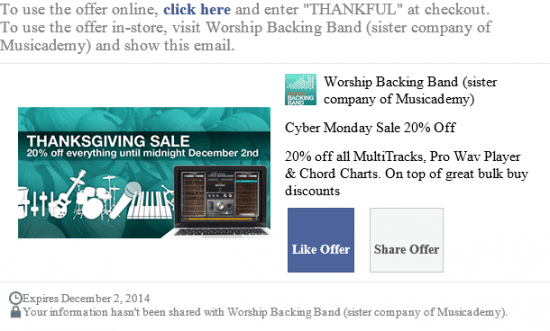
The initial Musicademy Offer got some good traction (34 offer claims from a Reach of 6,276 and spend of £40) so I decided to re-work the idea on Cyber Monday for the Worship Backing Band brand. Again I created an unpublished page post offer, made it live on the Page then scheduled the Offer Ad for a few hours later.

Here's the Worship Backing Band Offer and the email Facebook sends to those who take it up:
cyber monday offer

(Don't you just hate Facebook's default typeface and styling of this message?)

Customer reaction

There was the inevitable set of moaning from British customers about why we (as a UK brand) were embracing this American import and bowing to the gods of consumerism. It was great to see British fans coming to our rescue without us having to justify our actions (see a snippet from the conversation below).

rant alert

We also had the odd email from people miffed that they'd purchased at full price a few days before (we sent them some free stuff as a consolation and to our delight they ended up buying even more). One emailer told us we were being tight at only offering 20%. I didn't see many retailers being that generous across their ENTIRE RANGE (including titles that had only been released a few weeks previously). On reflection I think we could have played the game most retailers do in sales and simply cherry pick a few key products (many of which were already on half price sale) and slash the price dramatically to get the headline effect. But much of our objective was to increase average order value which a blanket discount offer had previously achieved.

Again we were able to counter this a little with our Cyber Monday email where we hit hard on the messaging to do with additional in-store discounts. The headline read "Did you think our 20% off Black Friday coupon wasn't generous enough?"

In terms of purchases the Cyber Monday email was twice as effective as that of Black Friday but do remember that it may also have served as s useful reminder to those that may still have been waiting to act on the Friday email.

So lessons learned for the future.

Reflections

Responsiveness was crucial throughout the campaign. Sure the ads and organic posts were scheduled but we benefited from me dipping in and tweaking copy, bids and targeting based on what real time results were telling me. I was also learning over the weekend from customer reaction, what other brands were doing and how the algorithm was working - all this informed the content I created for the last big push that was Cyber Monday.

This has also given us a glimpse of the future for promotional posts. Facebook is very much Pay To Play unless you have non-promotional content but with a clever use of budget (and for clever read putting in the hours researching, testing and setting up ads) you can get good results on very small budgets.

Comparing what I paid for the third party email list and Facebook ads I'd choose the ads every time. And I will continue to invest in building our own list organically and focus on serving them great quality content, building up trust and permission to occasionally talk to them about products. Pretty much the same way I feel about my Facebook newsfeed.


from Smart Insights http://ift.tt/1BTbZnv
via IFTTT

Case study: Disneyland global strategy

When Shanghai Disney Resort opens towards the beginning of 2016, it will represent just the latest move by western companies determined to entertain and profit from China’s new middle classes.

Chinese household spending on entertainment and leisure activities rose 56% in just one year between 2010 and 2011 and the rise in entertainment spend is predicted to continue for some time. Chinese consumers, or more specifically their newfound disposable spending power, are a serious target for the film and entertainment industry now scrambling to meet their desires.

Shanghai Disneyland

Cinemas are being hurriedly constructed and theme parks are booming as both local and foreign enterprises battle for a share of the market.

Theme parks are increasingly popular in Asia and in the last decade two of China’s theme attractions have entered the world’s top ten in terms of visitor numbers. About a third of the world’s top 25 theme parks are in Asia and it’s an industry that’s continuing to expand.

When it comes to theme parks, Disney is really the dominant force. All but one of the world’s ten most visited parks belongs to the company. The corporation already has a large presence in Asia, with popular attractions in both Japan and Hong Kong.

So, it seems logical that the theme park behemoth should want to expand further to cover more area in a region hungry to be entertained. Once up and running, Shanghai’s Disneyland is expected to be visited by around 17 million people a year.

Disney’s wider strategy

In opening Disneyland in Shanghai, Disney isn’t only chasing entrance ticket money from its successful theme park operation. The theme parks are just part of Disney’s wider media strategy, which sees the attractions fuelling the other highly successful division of its empire: films and television.

In its domestic market Disney’s own TV network, the Disney Channel, introduces children to the entire Disney experience, enabling it to promote its films and other merchandise. But foreign ownership of TV stations is restricted in China, so Disney’s approach will be to use its Asian theme parks for market penetration. This could see Disney using the theme parks to push its film titles such as Ironman and Spiderman, both selling well in Chinese cinemas, in order to increase merchandising revenue.

Although crowded with visitors, Disney’s parks are hugely costly to run and not all the parks always break even. Pricey entrance fees cover most of the costs of hosting visitors but the majority of the profits come from notoriously expensive food inside the park, as well as merchandising from strategically-placed gift shops at ride exits.

Disney uses a number of techniques to encourage repeat visits, such as changing the routes that different rides take through the attractions and adding so much decorative detail that it can’t all be taken in during one visit.

Numbers vary, but some parks (such as California) see high numbers of visitors who live locally whilst others see a high number of tourists from further afield. It’s likely that Disney will continue its approach of trying to encourage repeat visits to the Shanghai park.

Disneyland Paris – now one of Europe’s most-visited tourist attractions – sees such colossal visitor numbers that it’s had significant regional impact. It’s estimated Disneyland Paris has contributed $50bn to the Paris region’s economy and added a significant chunk to France’s foreign exchange income as overseas visitors flock to the attraction.

With Shanghai already an important regional hub, the presence of Disneyland is likely to distort the local economy, encouraging visitors to stay longer to attach a theme park visit onto their stay.

Discordant voices

Although some voices grumble about American cultural imperialism and the social divisiveness of having such high ticket prices, the view from China is generally optimistic.

It’s thought the Disney corporation’s meticulous attention to detail and service standards – not to mention cleanliness and safety – could have a positive influence on the region’s theme park industry. It’s also likely that rivals and copycats will emerge around the region to cater to those that can’t travel to Shanghai, or can’t afford Disney’s stratospheric prices.

One expat blogger writing from China decided to break into the building site for the new Shanghai Disneyland and have a preview. His observations as to what the new park would be like were rather cynical.

“These kinds of theme parks are perfect for China–fun is fenced in, delimited into zones…There will be long lines which VIPs won’t need to stand in…. It’ll be packed and everyone will love it. They will have to because they will have no choice… No spitting or smoking or pissing in public will be allowed–but it will happen anyway. The moat will fill with trash and pollution.”

For Disney the important question is not how difficult it will be to keep the moat clean but whether the park will turn a profit. Although the company’s 13 theme parks attracted over 130m visitors in 2013, not all of them have consistently turned a profit and some have needed financial bailouts from the corporation. With huge running costs, even Disney’s most popular theme parks aren’t guaranteed to make ends meet.

But the local presence of a major brand flagship such as this one is likely to be significant strategic move for the Disney corporation, and one that will complement its other ventures. It’s an opportunity to capture the imagination of a market that hasn’t grown up with Disney-owned Star Wars and Indiana Jones but could be introduced to these and other money-spinners such as Frozen and Toy Story.

Other growth areas in Asia which would be obvious targets for Disney include children’s educational media. With household incomes focused on a single child, and parents keen to invest in educational opportunities that will give their child an advantage, there’s a huge potential market for Disney’s educational games.

Disney’s already had to adapt its culture to accommodate local attitudes. In Disneyland Paris, the locals reacted with horror when alcohol was initially banned from the park and Disney eventually reversed the policy.

The Haunted Mansion ride, popular in the US park, changed its title to Mystic Manor for the Hong Kong park and dropped the ghosts. Superstitious Chinese culture wasn’t ready to consider ghosts as jolly entertainment.

Disney’s even rejigged the park layout in Asia, moving away from an epic ‘Main street’ approach into the park and bringing visitors in via a large park which can accommodate local cultural events. And of course the refreshments have been localised, with popcorn now available flavoured with soy sauce and mochi dumpling snacks carrying Toy Story themes.

It remains to be seen if the Shanghai Disney Resort will cover operating costs. For the Disney corporation, this major regional flagship may be more significant as a branding experience than as a money spinner in its own right.

China’s entertainment market is still being sliced up by media conglomerates: the opening of the new theme park is a significant move by a major industry player which will help determine the direction of this industry in the region.


from Smart Insights http://ift.tt/21AT786
via IFTTT

giovedì 3 dicembre 2015

Things to consider when selecting an Email Service Provider [Infographic]

Use this infographic to evaluate what you need from your Email Service Provider

Selecting a good ESP is essential to drive your email marketing efforts to the next level, attain SMART goals and derive adequate results. Without in-depth data analysis, your ability to take clear decision gets paralyzed.

Managing email bounce

Managing the bounces could be a daunting task. So, how to manage bounced emails? Well, most leading email service providers allow you to actually dig deep into the reason for such bounce. You could have the flexibility to check out the bounce headers, determine a hard or soft bounce. Normally, good ESP will remove contact from the list directly if it’s a hard bounce. If it’s a soft bounce, a good ESP might allow you to make up to 3 attempts, but if there are any further rejections, you might have to remove the email address then.

You can prevent bounce rate with double opt-in subscription, list management, right frequency, and send time etc.

Managing and pulling data

A good ESP will offer third party integration and bring the data sets from your CRM, e-commerce carts, website and other automated third party apps. Moreover, majority of good ESPs will also offer integration via API enabling you to pull more data and use it in turn for campaign planning. As a pro tip, check the API support, the easier the better.

Support and Escalation

Support is another crucial factor that needs a great deal of consideration. Many ESPs only support customers for specific hours or not lend any help over the weekends, but an ideal ESP will come with 24/7 support along with extending a local support to your marketing office. Some of them also have a live chat or call in facility. While evaluating support, also consider escalation time and issue solving period. The quicker the escalation time the easier the resuming.

Things to consider while choosing an ESP Infographic
Thanks to Email Monks for publishing this Infographic

Anyone looking for more in-depth advice for selecting and comparing an Email Service Provider can download our selecting an ESP guide. It's free to basic and expert members.


from Smart Insights http://ift.tt/1lysXBZ
via IFTTT

Reducing Abandoned baskets and boosting conversions

Analysis and actions showing the best ways to increase your conversion rate

An abandoned basket is exactly as it sounds; it’s when a visitor who already added a product/service to the shopping cart then, for whatever reason, abandons their shopping cart and never proceeds to make a purchase.

At best this is very frustrating; at worst it can be a business critical problem for your ecommerce site.

However, it’s not all bad news; your visitor at least managed to find your website and even went as far as selecting a product to add to their shopping cart.

This is a solid foundation to build on, but how can we reduce these instances of online shoppers abandoning their baskets?

Find out where customers are exiting from your checkout flow

Your “checkout” flow describes the entire process of buying a product via your website, from to adding an item to basket, through to completing payment.

A good place to start is by identifying poor bounce rates across key sales pages on your site. You may have multiple landing pages for different products, perhaps all differently designed, so you’ll likely have different bounce rates figures.

Look into the behaviour section Google Analytics and find landing pages. From here you can easily identify pages with a high bounce rate.

Google analytics bounce rate

Try combining Google Analytics with the Page Analytics extension for Google Chrome. This handy app will generate an overlay on your website showing the click through rates (CTR) for all the links on your page.

Using this data you can easily make a call on which links on the page are worth keeping, links that may need removing (as they generate few clicks), or perhaps you may need to consider giving popular links even great visibility on a page to maximise CTR.

The above methods will give you some useful data which will enable you to make some informed decisions on what might be affecting bounce rates and causing abandoned baskets.

However, there’s no subsite to being able to visualise how users are interacting with your pages – this is where heatmaps come into play.

Hot jar

A heatmap can demonstrate where customers are most commonly clicking on a page, or even where the average cursor position is. This data can help solve common problems such as…

  • Identifying non-clickable elements users are actually trying to click (such as an icon that looks like a button)
  • Are your most important content and elements below the fold – is this affecting CTR?
  • Are non-important elements of the page attracting too much attention from your visitors, thus impacting important call-to-actions?

Why might visitors not convert?

By this point you might have some clues as to when and why customers are dropping out of your checkout flow, so now let’s take a look at why they aren’t converting.

Ask yourself these key questions when trying to identify poor conversion rates:

  • Is it totally obvious what action a customer is supposed to take? Customers often need a little helping hand when landing on a sales page. Is it really that obvious to them? Make call-to-actions stand out and ensure visitors know exactly what to do.
  • Did your visitor expect to land on this page? If your visitor clicked through to your sales page expecting to see “Playstation games”, they will quickly bounce if the page is actually about “Playstation consoles”. Be relevant! Don’t use irrelevant hooks to trick customers into clicking, as ultimately traffic gleamed from this means is pointless.
  • Does the page answer all potential customer questions? Try to include as much information a customer will need to make an informed purchase. Try including an FAQ on your landing page – this is a great way to work in some keywords, boost your word count and stop the temptation customers might have of finding the information they need by searching elsewhere online.

Get customer feedback

There’s no substitute to genuine customer feedback, so start engaging your loyal regulars to get their thoughts as to how you can improve.

Use in-page polls and prompts to catch customers as they are going through the sales funnel, this way you can catch useful feedback as it’s fresh in their minds. It’s possible to catch this information via a timely non-invasive pop-up / pop-under.

Alternatively get real people to test your site, something that livetesting.com offers using their pool over a million testers. You can then analyse videos of these users navigating your site before they then answer a few questions about their experience.

There is also a way of trying to negate instances of abandoned baskets in real time; use live chat. Live chat usually takes the form of a simple pop up module that’ll appear on a landing page – often after a visitor spends a particular amount of time on a page without taking an action or, conversely, have taken a particular course of action.

If a visitor has been stuck in your checkout flow for a while, it might be safe to assume they are having some trouble, at which point you can save the day buy guiding them through to the checkout using live chat.

Use abandoned basket emails

Even if your efforts decreased instances of abandoned baskets on your site, you’ll still inevitably have customers that inexplicably bounce from your site after adding a product to the shopping cart.

However, you still have a chance to reach out to these customers.

Abandoned basket emails allow you to contact customers to give them a friendly reminder that they left something behind.

You can approach this in a couple of ways; try asking the customer if they needed some help, or if had any questions about the product before they commit to buy it.

Cart abandonment

(Above: The LCN.com abandoned basket mailer)

Or perhaps the customer needs a further incentive to push them towards that checkout page; trying offering a tempting discount on the product they were interested. If you do decide to offer money-off a product, make it time sensitive to instil a sense of urgency.

How to improve on-site conversions

Using the above methods you can start to understand why your conversion rate might not be as high as it could be – now it’s time to start improving that all-important metric.

A fantastic conversion rate is the holy grail of any marketer. You could have all the traffic in the world but a conversion rate 0% is not going to make you any money, so in some cases it makes more sense to improve conversions rather than chase traffic. Fix conversions first, and then bring in the traffic.

Here are few fundamental things to consider when trying to boost conversions on your site.

Make your site faster

A slow website is a common cause of a high bounce rate. Nobody waits for a slow site to load and an agonisingly slow page can cause customers to lose faith in your site / company all together.

“If they can’t even get their website working properly, why would I buy from them?”

Google’s PageSpeed Insights and YSlow will give you some ideas on what is wrong with your site and how you can get things moving faster.

For more details on speeding up your site check the LCN guide to PageSpeed Insights

Improve your call-to-actions

Call-to-actions (CTAs) are vital for instructing your visitors on what do on your page. Once on your visitors has landed on a page is it clear what the next step is? Are they supposed to add something to the basket? Check a radio button? Move on to another page? Sign up to a newsletter?

CTAs often take the form of buttons which act as simple visual clues for visitors. The positioning of CTA buttons is key, especially if they represent different actions for different products. Button size and colour can all have an effect on click-through-rates – however, copy arguably plays the biggest part in creating the perfect CTA button.

For instance, common CTA button copy might be something along the lines of “Subscribe now to receive our newsletter”. Let’s take a closer look at that CTA.

  • “Subscribe”: This is the action your user should take. This should be simple and leave the visitor in no uncertain terms about what they need to do.
  • “Now”: This creates a sense of urgency to encourage the visitor to take action ASAP, whilst they are on the page.
  • “To receive our newsletter”: This adds some context to your CTA. It goes without saying that you won’t get many subscriptions if you do not make it clear what user will be subscribing to!

Conclusion

These are just a few ways of improving conversions and reducing the problem of abandoned baskets. For a more in-depth guide take a look at my original post on conversion rate optimisation.

Low conversion rates and frequently abandoned baskets may be a sign of a poorly designed or confusing website, but there are positives – people are finding and engaging with your site in the first place. Now all you need to do is get to work and improve.


from Smart Insights http://ift.tt/1LQABgu
via IFTTT

What is Digital Marketing? A visual summary.

Defining the scope of digital marketing is essential for businesses to get the most from it

Smart Insights exists to help advise marketers how to best plan and optimise their use of integrated digital marketing, but recently the term digital marketing has had a fair bit of criticism. Dave Chaffey’s recent blog post on digital marketing trends considered if we were going to be entering a ‘post digital’ era, while PepsiCo exec Brad Jakeman called digital marketing ‘The most ridiculous term I’ve ever heard’. Similarly, Amanda Rendle, global head of marketing for HSBC decided to ban the term ‘digital’ in her team because she thinks that to talk about having a digital team when all consumers exist in a digital world is anachronistic. It’s a bit like calling cars ‘non-horse drawn vehicles’ – there is no need to specify it isn’t horse drawn anymore.

All well and good, but it doesn't reflect the reality of the adoption of digital marketing; maybe in ten or fifteen years this will be the case, but right now, a huge amount of marketing departments are currently transitioning to being more digital focused, with many still a long away from being ‘digital first’ organisations. Our research showed that over half of large organisations don’t have a ‘digital strategy in place’. Clearly digital marketing is not the default and does need a term to quantify it and differentiate it from traditional marketing.

Digital-Marketing-Strategy

Defining digital marketing

The use of the Internet and other digital media and technology to support ‘modern marketing’ has given rise to a bewildering range of labels and jargon created by both academics and professionals. It has been called digital marketing, Internet marketing, e-marketing and web marketing and these alternative terms have varied through time...

digital marketing

Digital Marketing is the term most frequently used today, as we can see from these digital marketing definitions in Google Trends, so that is the term we focus on.

Because of the recent debate about the use of the term ‘digital marketing’, we thought it would be useful to pin down exactly what digital means through a definition. Do definitions matter? We think they do, since particularly within an organisation or between a business and it's clients we need clarity to support the goals and activities that support Digital Transformation. As we'll see, many of the other definitions are misleading.

Boiled down to its simplest form, digital marketing is defined in Dave Chaffey's book Digital Marketing: Strategy, Implementation and Practice as simply:

Achieving marketing objectives through applying digital technologies and media.

Dave expands on this definition of digital marketing to explain that, in practice, digital marketing includes managing different forms of online company presence and presences such as company websites, mobile apps and social media company pages. This is in conjunction with online communications techniques including the likes of search engine marketing, social media marketing, online advertising, e-mail marketing and partnership arrangements with other websites. These techniques are used to support the objectives of acquiring new customers and providing services to existing customers that help develop the customer relationship through E-CRM and marketing automation. However, for digital marketing to be successful, there is still a necessity for integration of these techniques with traditional media such as print, TV and direct mail as part of multichannel marketing communications.

If we look at these other definitions of digital marketing such as this definition of digital marketing from SAS: What is Digital Marketing and Why does it matter? or this alternative definition of digital marketing from Wikipedia we can see that often there is a focus on promoting of products and services using digital media rather than a more holistic definition covering customer experiences, relationship development and stressing the importance of multichannel integration. So for us the scope of the term should include activities across the customer lifecycle:

  • Digital media and communications channels
  • Digital and mobile experiences such as web design and mobile apps
  • Prospect and customer relationship management through marketing automation
  • Digital strategy and integrating multichannel communications and experiences
  • Digital technologies and platforms to manage all digital marketing activities

The role of digital platforms in supporting integrated multichannel marketing is an important component part of digital marketing, yet is often overlooked. In many ways, this highlights how important it is to break down silos between ‘digital’ and ‘traditional’ marketing departments. Online channels can also be managed to support the whole buying process from pre-sale to sale to post-sale and further development of customer relationships.

Optimising digital marketing can be tricky, and a simple definition does not necessarily translate into something that is useful for achieving business objectives. That is where the RACE Digital Marketing Planning framework comes in, as it can help break down digital marketing into easier to manage areas which can then be planned, managed and optimised.

Our graphical summary definition of the scope of digital marketing

To answer the question 'What is digital marketing?', we have put together this new visual definition summarising all the activities that form digital marketing that need to be managed across the Smart Insights RACE Planning framework. It's used in the new, 6th edition of Dave's Digital Marketing book. We explain best practices for all of these in our Digital Marketing Elearning course.  The infographic is divided into activities to develop and manage digital strategy at the top to the marketing activities at the bottom.

Digital marketing definition using the RACE planning framework

It is important to remember that just because digital marketing uses different communications techniques to traditional marketing, its end objectives are no different from the objectives that marketing has always had. It can be easy to set objectives for digital marketing based around ‘vanity metrics’ such as number of ‘likes’ or followers, so it is useful to bear in mind this definition of marketing advanced by the Chartered Institute of Marketing:

"Marketing is the management process responsible for identifying, anticipating and satisfying customer requirements profitably".

This definition emphasises the focus of marketing on the customer while at the same time implying a need to link to other business operations to achieve this profitability. Dave Chaffey and P.R. Smith note that digital marketing can be used to support these aims as follows:

  • Identifying – the Internet can be used for marketing research to find out customers’ needs and wants
  • Anticipating – the Internet provides an additional channel by which customers can access information and make purchases – evaluating this demand is key to governing resource allocation.
  • Satisfying – a key success factor in digital marketing is achieving customer satisfaction through the digital channel, which raises issues such as: is the site easy to use, does it perform adequately, what is the standard of associated customer service and how are physical products dispatched?

Conclusion

So, digital marketing is about utilising digital technology to achieve marketing objectives. There is no essential need for digital marketing to always be separate from the marketing department as a whole, as the objectives of both are the same. However for now it remains a useful term because digital marketing requires a certain skill set to utilise the digital technology effectively. As our recent Developing Digital Skills report showed, many marketers are now spending > 50% of their time on digital marketing activities and two of the three top job roles in marketing are digital, so clearly digital skills are needed.


from Smart Insights http://ift.tt/1NIYrCd
via IFTTT