Slideshare

mercoledì 15 gennaio 2014

Slideshare: An essential B2B Marketing Tool

Ideas to increase visibility and sharing on Slideshare


I thought this was a nice piece of content marketing by Slideshare, so thought it was worth sharing to highlight Slideshare’s ongoing importance if you market to professional B2B audiences. As Dan said in this previous post on 7 Reasons B2B marketers should love Slideshare:


“Assuming that you’re a B2B marketer, and have good content that can be directly used or re-purposed for Slideshare, we think that Slideshare is a grossly under-utilised tool, especially since the “Pro” version launched”


This new Slideshare from Slideshare is worth scanning if your a B2B Marketer since it’s a nice summary of what worked for companies recently with examples.


Apart from the deck itself, the content marketing I liked is the use of a personalised email sent to all Slideshare users with an autogenerated HTML5 infographic. This is an example for my Slideshare page – it shows how Slideshare can reach many people if you have the right type of shareable content developed through time.


Slideshare-marketing-example


My 59 updates are different talks over many years. A lot of the views are down to one Slideshare boosted by Slideshare ranking it favourably within Google – another benefit of Slideshare. You can reach new people by the SEO effect as well as the viral effect.


In Dan’s original post he shared an infographic describing Slideshare as the “Quiet Giant of Content Marketing”. It’s pretty noisy these days with the amount of competition, but worth considering for repurposing content specifically for if your audience uses it.


from Smart Insights http://ift.tt/1d5wrjp

via IFTTT

giovedì 2 gennaio 2014

Affiliate Marketing 2014

Affiliate experts share their frustrations from 2013 and expectations for 2014


Affiliate Marketing had a big year in 2013 with the industry now estimated to be worth a staggering £9bn. With that in mind I asked some thought leaders in the Affiliate Marketing industry for some of their thoughts on 2013 and what they think will change in 2014.


A big thanks to Kevin Edwards, Strategy Director at Affiliate Window, Helen Southgate, UK MD Affilinet and Owen Hewitson, Associate Director Acquisition from Starcom MediaVest Group.


2014 is fast approaching. Where do you think we will see the biggest changes over the next 12 months?


Helen Southgate (HS): I’m not sure we’ll see any big changes as such, more a developmHelen Southgateent and progression of the current channel. There will be some regulation areas to look out for though. The RMR comes into effect from 1st Jan meaning cashback cannot be used in the utility sector. The “cookies” legislation is still ongoing and is not likely to be resolved soon. The FCA will likely want to show their worth since taking over from the FSA so I wouldn’t be surprised if we see some potential impacts there in the financial sector. The IAB AMC is keeping tabs across all of these changes and will keep all relevant stakeholders updated.


Owen Hewitson (OH): The biggest challenge in our industry lies in how we represent ourselves.Owen1 Collectively, affiliate marketers have been guilty of far too much naval gazing and talking to ourselves about ourselves. As a result we have taken our eye off the ball when it comes to how those outside of our channel see us, and where we fit in the multi-channel mix. The challenge for 2014 is to recognise this and reposition our industry as an acquisition-focused delivery mechanism. I offered my view on how we can do that earlier this year.


Kevin Edwards (KE): I would like to think we’ll see the industry working with third parties toKevin Edwards crack the cross-device challenge if individual companies cannot do it themselves. We’re way past the tablet and handset tipping point and all research shows us consumers are interacting with multiple devices in order to purchase online. Without additional insight into what this journey looks like the affiliate channel, like any other digital channel, will effectively be working blind.


I’m sure individual companies must be assessing what they can do, so the challenge will be whether they innovate or they rely on piggy backing someone else’s technology to understand consumer behaviour.


The other change will be a further move towards granularity. The industry has been working to drill down and down into data, and we work reasonably effectively on a granular level, but more and more affiliates will recognise the power of their data and use this to build better client relationships – as well as to create additional complexity and sophistication in our understanding of the channel.


How have you seen mobile impact the channel and how do you expect this to evolve?


HS: I always find the question of mobile entertaining as mobile has affected us much the same as most other digital channels. I read a lot of reports in the industry about the growth of mobile and always wonder why we are surprised at this and why it is headline news. It’s a change of consumer behaviour that’s not limited to the affiliate channel, and one pioneered by the genius of Apple! Despite talking about it a lot and releasing lots of data, I don’t think that anyone in digital or the affiliate channel has totally embraced mobile, probably because it’s moving so fast.


If I think about my Christmas day at home the room will have 3 iphones, 3 ipads, 1 kindle, 1 Hudl and a smart TV. I think the industry has struggled to keep up with the rapid change and growth of technology in this sector, but when we do get it right it will be hugely valuable. It’s about getting the right message, to the right person, at the right time and in the right format. There are so many opportunities going forward which not just the affiliate industry needs to embrace but also the broader digital industry. Once they catch their breath that is!


OH: I think that some of the developments in mobile such as receipt scanning apps could help ease the introduction of many FMCG advertisers into industry where traditionally it’s not been clear what their place could be. Looking ahead, there are some interesting technological developments on the horizon that have immediate applicability to our industry. Apple’s iBeacon technology, which use Bluetooth Low Energy (BLE) to transmit or receive with an app to offer micro-location awareness may not be immediately applicable for publishers’ apps but provides a huge opportunity for app download campaigns as retailers start a land grab to get their apps on consumers’ devices.


But in the latter part of 2014 there will be one major new development that I foresee as revolutionising mobile: Glass. With Apple hardly innovating in mobile technology it’s only Google that has the capability to produce a game-changing device. I’m not convinced by any of the wariness around Glass and expect that its extraordinary features will outweigh concerns around looking stupid when wearing it. This time next year I expect that when we talk about ‘mobile’ we’ll mean much more than just phones and tablets.


KE: It can’t be understated how much of an impact mobile is having and will continue to have but few people have crystallised the opportunity well. I think we’re all confused by what we’re supposed to be focusing on and that lack of vision has led to a scatter gun approach with some companies throwing everything at mobile in the hope that some of it will hit the target.


For me the focus has always been about evolving e-commerce into m-commerce. It’s frustrating that we’re still talking about tracking as being a challenge: that a network can make a statement that 75% of their mobile sales track and pass it off as a positive news story is pretty damning when some clients are seeing one in three or one in four sales through handsets. Let’s not run before we can walk: app download campaigns, mobile wallets and Display are all well and good but if we’re haemorrhaging revenue that should, by right, be ours, then we’re doing a pretty poor job.


I want 2014 to be the year when we stop talking about the ‘tracking challenge’ and we start talking about clearly defined mobile opportunities for both existing and new affiliates.


What has been the biggest development in 2013 for you?


HS: Personally, the growth of the UK business at affilinet. We have had a very strong year despite a slow summer period for online which has been mitigated with a strong end to year. The UK market is really dominated by one affiliate network but I think there is room for a quality network, with excellent people looking to deliver top class affiliate marketing; and this is what I intend to do.


OH: The publication of the IAB’s Online Performance Marketing Study was a major step forward in demonstrating the maturity of our industry. Whereas previously the best guess of the value of performance marketing was Econsultancy’s slightly finger-in-the-air guess, now we have a study that’s concrete, broad and properly-audited. That another is planned for publication in 2014 can only solidify the progress made by this year’s.


KE: From an Affiliate Window point of view it’s been the transformation in how we process data internally. The insights we have as a network now, compared to a year ago, have changed how we approach certain elements of the business and how we talk to clients. I think data should be about empowerment: unlocking the potential to make better business decisions. And as soon as you start to unlock one dataset, another presents itself to you.


On a more macro level, seeing how affiliate marketing is perceived in the UK by overseas affiliates and advertisers has been eye opening. We have an industry we should be very proud of and is hugely appealing. There’s great untapped potential there and we should all be working harder to bring it to these shores.


It goes without saying that Google continues to cast a long shadow and we know anecdotally some traditional affiliates continue to slip from the channel. The revenue is being replaced with new blood but it’s critical we try and ensure we support those who are struggling. This should be a USP for networks but I don’t think any of us are doing enough.


What have been your major frustrations of 2013?


HS: A lot of talk and little action. I’ve seen a lot happen in our industry over the years and our industry has definitely grown and professionalised, however I feel the industry has lost some of the entrepreneurial spirit that it used to have. I feel that some apathy has crept in at all levels of the industry from networks, to advertiser, to agency and to publisher. I hope we get some of that spark back as we need it to not only grow, but to fight to keep what we already have.


OH: Amongst budget-holders both client side and internally to organisations our industry seems to suffer from a confusion between the aim of activity and the channel through which it should be run. Very often a client request for a mobile acquisition campaign (for example, an app download campaign) will be funnelled to a mobile team or agency that will then typically run a display-based campaign. But the original requirement was to produce app downloads, which is an acquisition, the budget for which should therefore naturally sit in our channel. Likewise with email. A client’s request for an ‘email strategy’ should not be interpreted to mean simply that they want to send more emails. In most cases, there is an acquisition-based KPI behind such a request that is front-and-centre of a client’s mind as an aim, even if articulated with reference to a channel. We are better placed as an industry when we can put ourselves in a position to identify that need.


KE: Poor decisions based on perception rather than fact. This is nothing new but nothing irritates me more than the peddling of certain beliefs that are passed on as fact when little critical analysis has been done to prove or disprove them. I’m also not a fan of multi-attribution commission models and have seen a certain creep (still a trickle rather than a flood) towards them that worries me.


It’s also depressing that networks seem content to appeal to the lowest common denominator as a point of differentiation to win business: price. It commoditises a complex channel and makes us all poorer, with fewer resources to support what is still by far the best solution for most advertisers looking to run affiliate programmes.


What should brands be doing to get the most out of affiliate marketing in 2014?


HS: Working closely with their networks to understand the value of their affiliate channel throughout the customer journey. The channel is diverse and wide-reaching yet we focus too heavily on the short-tail of publishers. To have a truly sustainable and scalable programme naturally you need to focus on the short-tail, but nurturing a long-tail will drive awareness and actions and advertisers will reap the benefits.


OH: For me, the obvious answer is to focus on the post-sale story. Rather than getting bogged down in fruitless debates about cross-channel or multi-channel attribution that seek to weigh the contribution of each channel and apportion a budget on the basis of a perceived value from sitting in a certain part of the user’s path-to-purchase, we should look at what happens after the conversion. Or more precisely, what the customer referred via the affiliate actually looks like – their relative value to the advertiser against other channels, and against other affiliates, in terms of metrics that would indicate this value. This is incredibly simple to do, requires no technological trickery and does not necessarily mean interrogating huge amounts of data.


Whether the affiliate channel produces customers with higher spend than other channels can be ascertained simply by looking at AOVs; whether affiliate-referred customers are more loyal can be demonstrated simply by looking at churn/retention rates. Advertisers that have done this have generally a very positive story to tell about the affiliate channel, a fact I have argued for earlier this year and which I believe we should seek to emphasise in case studies and media packs in 2014.


KE: Challenge your network on your data. Think of all the parameters you collect when storing affiliate sales and how these can be linked to provide better insights. It goes without saying that not all affiliate traffic is equal but this understanding needs to work across the whole purchase cycle from initial interaction to longer term customer value. A network typically only captures a certain segment of that data so when brands challenge them on making informed decisions, appreciate the limitation of what they have access to in order to do so. If you don’t have the ability to challenge that data, give it to your network who might be able to do it for you.


Get stuck in and allocate more resource to it: don’t judge purely on pricing and challenge your network on who your affiliates are, where their traffic is coming from and how you can work better with them.


The basics haven’t changed over the year: there remain few shortcuts, but if it’s not already, try and make 2014 the year your programme turned intelligent.


from Smart Insights http://www.smartinsights.com/affiliate-marketing/affiliate-marketing-strategy/affiliate-marketing-2014/

via IFTTT

lunedì 30 dicembre 2013

14 practical marketing ideas to trial for 2014

From social media marketing to Google Analytics


Feeling jolly at Christmas, I wanted to be useful . And thought, if you find a little time in-between now and the New Year, it’s a good opportunity to do a little social media housekeeping. Here are immediate future’s top 14 recommendations (seriously, we are doing our tidy up too!) that will improve your social footprint no end. Get them all done and you’ll hit the ground running in January!


  1. Verify your Google profile – Google+ made huge advances this year but try some simple updates. If you haven’t already, customise your URL so your company page is legitimate and easier to find and share.


  2. Prepare for a crisis – While it’s quiet, take a step back and look at the risks and vulnerabilities in social. Where could you improve? How will you go about making change? Who else in your company could you tempt with mince pies to get some advice? And save your social posts using the lovely Social Safe – http://bit.ly/savesocial -‘just in case’


  3. Read “Share This Too” – A great book on social. And not just because we are co-authors, but because it has insights from over 30 of the leading practitioners in social media and PR! (it’s produced by the CiPR too)


  4. Test Twitter Cards – Get to grips with Twitter’s Lead Generation Cards; these allow you to collect leads directly from tweets. Christmas is a great time to trial new things, and these have no form for users to fill in – an added bonus!


  5. Review existing content – Now is a good time to look back at resources and images. How do they look? Are they all on brand? Dig into your audiences and plan ahead to deliver the hard-hitting content that they want. Be creative. Experiment!


  6. Take a Google Analytics course – Insights are everything. Make the most of your time off over Christmas and brush up on your analytical skills. It used to cost $50 but now you can learn for free!


  7. Do more with LinkedIn – Sponsored Updates let businesses promote any post from their company page directly into a specific demographics’ news feed. It’s the coolest thing since sliced bread, and leaves a trail of breadcrumbs for your customers to follow.


  8. Champion your success – Had a good year? Tell your colleagues about it! Show-off your work with internal presentations, newsletter and creative comms using Vine, videos, infographics… Celebrate your social success!


  9. Competitor analysis – Step back to get a better view of the landscape. Take stock of threats and opportunities and work them into a viable framework to build up your online strategy.


  10. Play with video – Now you can create and edit videos on the Instagram app as well as photos. And what’s more, these videos exceed the 6 second restriction of Vine, so it’s worth testing which platforms work best for you.


  11. Get on the right side of the law – The UK legal system wasn’t made with social in mind so it has had to adapt. Get better prepared for legislation in 2014 with our free resource (including real life examples of what not to do, it’s well worth a read!) Download Risky Business: How to stay legal when using social media.


  12. Lay down the law – Once you’re aware of the legal risks, you’ll no doubt want to get your housekeeping in order. Download The Social Media Policy Workbook to draft your new company policy; it covers everything from changing passwords to protecting the company against liability caused by your workforce.


  13. Cut your losses – Think about the platforms that you’re using; do they suit your brand? Are you reaching your audience effectively? Close down redundant profiles and re-focus your efforts on active sites.


  14. Surf the net for inspiration – This is a great time to do a bit of research. Some casual surfing can land you with great ideas for the next twelve months. Start by checking out what competitors have been up to!


So there you have it. 2013 was the year that Twitter went public, Facebook launched Graph Search, and Instagram allowed video and Direct Messages. Next year looks to be more eventful. So getting a few of these tasks done will stand you in great stead for 2014. And do shout of you need a bit of advice! I am happy to help.


All the best for 2014!


from Smart Insights http://www.smartinsights.com/managing-digital-marketing/personal-career-development/14-practical-marketing-ideas-2014/

via IFTTT

giovedì 19 dicembre 2013

Designing out of “Stuck”


via Digital Strategy http://digitalstrategy.typepad.com/digital_strategy/2013/12/designing-out-of-stuck.html

mercoledì 11 dicembre 2013

6 Email marketing trends for 2014

In webinar we covered Six Trends showing techniques and examples businesses can use in 2014 to increase the value of Email marketing.


The six trends, if you want to fast forward, are:


  • Trend 1 – More Email 5

  • Trend 2 –Offline gets digital 16

  • Trend 3 – Majority mobile 21

  • Trend 4 – Video 33

  • Trend 5 – Open rate retires 37

  • Trend 6 – Intelligent inboxes 40


This Slideshare was presented as a webinar by Tim Watson of Zettasphere at the Smart Insights Digital Marketing Priorities 2014 summit.


You can view all 6 recordings from the Digital Marketing 2014 Summit here.


from Smart Insights http://www.smartinsights.com/email-marketing/email-communications-strategy/email-marketing-trends-2014/

via IFTTT

martedì 3 dicembre 2013

How to Select and Prioritise Your Testing

What’s wrong with endless button colour testing?


Disclosure: We DO test buttons. Size, prominence, copy, positioning and very occasionally, colour.


However, in many cases there are higher value tests that we could be running. There will almost always be constraints that limit the number of tests that you can run, based on design & developer effort, a limited number of conversions, limitations of your tools, etc. Therefore prioritising your tests is absolutely crucial. Where can you get the most bang for your buck? In this post I will share the most important things to consider when choosing what to test.


Selecting What to Test


selecting-tests


If you’ve been working on Conversion Rate Optimisation (CRO) projects for any length of time you’ll know that there is a huge range of ways to capture insights on user behaviour. No matter which tools/techniques you use, here are the three areas you absolutely must have covered.


1. What is the data telling me about visitor behaviour?


This is typically but not exclusively, found through your web analytics tool. Web analytics can provide a range of insights that help you to understand where people are abandoning forms, bouncing, hitting error messages, which devices/countries/browsers are under-performing,


Key areas to consider:


  • Top landing pages

  • Pages with high footfall (traffic)

  • Key leak or conversion points


2. What are users telling me about their experiences? What can we observe about their behaviour?


If web analytics can help us to understand ‘what’ users are doing, user research can start to fill in the picture by tackling the ‘why’ behind user behaviour on areas such as;


  • Usability errors

  • Relevance, persuasion, motivation

  • Influential proposition messaging


3. What does the business know about customer struggles or business challenges?


Finally, don’t overlook what your business knows about customer behaviour. Often people within the business have valuable information about common user errors, feedback from social media, feedback from stores, etc.


“If only HP knew what HP knows, we would be three times more productive.” Lew Platt, CEO, Hewlett-Packard


I love this quote. It highlights the importance of setting up communication channels for feedback and suggestions. This can be a really positive process that gains support for your testing programme.


Key Sources:


  • Customer service insights

  • Merchandising team

  • Store staff


Prioritising your tests


prioritising-tests


So now you’ve got tons of exciting ideas and you’re ready to start testing, but where to start? Here’s a few key considerations that we have found invaluable when developing our testing schedules.


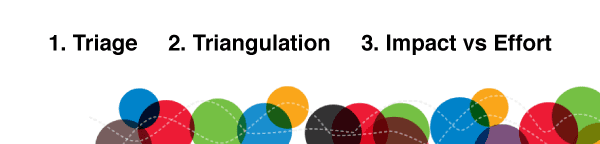
1. Triage


Firstly, it’s important to identify if an issue or improvement is worth testing or can be tested. Armed with insights from regular analytics investigation, a range of user research techniques and internal feedback you’re almost certain to have more hypotheses than you can test. Some things will be too small to warrant testing and may be best implemented as a JDI (Just Do It) change, while some may require new functionality or a more comprehensive redesign that sits above testing (e.g. a full checkout redesign).


Here are the categories that we use to triage ideas/improvements:


- Just Do It (JDI) – A small changes that can be implemented without testing and monitored using analytics.


  • Single Feature Test – a specific test on a single issue

  • Batch Testing – a test on a range of small changes with a similar theme

  • Radical Redesign Testing – A full-page redesign tested against the current version.

  • Larger Redesign Projects – Improvements that are not practical to test and require a more in-depth redesign process.


Ideas might not fit neatly into one of these categories, but by thinking in this way it will help you to start thinking about the scale of issues in a pragmatic way.


2. Triangulation


Once we have classified issues into different levels we look for issues that have been identified in multiple research methods. If multiple sources confirm or strengthen the same issues we give them a higher priority.


3. Potential Impact vs Effort Required


The next step is to start to evaluate the estimated potential impact of the improvement, against the effort required to run the test. This might be the amount of design or development required, creation of test assets, test configuration, level of sign-off required, etc.


So your estimate should be based on a balance of the ‘likelihood to impact key metrics’ versus ‘effort required’.


Summary


Selecting tests based on understanding the ‘hows’ and ‘whys’ of user behaviour, and prioritising tests in a considered, pragmatic way you will give you the best chance of running tests that have a significant impact on key metrics that improve the overall performance of your site or business.


How do you prioritise tests in your organisation?


from Smart Insights http://www.smartinsights.com/conversion-optimisation/conversion-optimisation-strategy/select-prioritise-testing/

via IFTTT

lunedì 2 dicembre 2013

What if Santa was an email marketer?

A little fun to end the year


santa-email-marketing

Santa discovers his Android rendering sucks…


If Santa was an email marketer…


  • 1. He’d be the only one who could claim “open rate” is a meaningful metric.


  • 2. He wouldn’t have to worry about people complaining they get “too many” presents from him.


  • 3. The message on the gift tag would be limited to 50 characters and always feature first-name personalization.


  • 4. His detailed tests on the “best time and day to send” would have extremely conclusive results (but at least a dozen experts would try and persuade him to always send on a Tuesday at 3pm).


  • 5. Around half the recipients would get their presents while out and about. Some would open them immediately, while some would wait until they got back home. And some would check the gift tags, save the valuable looking gifts for home, and dump the rest in a nearby bin.


  • 6. Nobody would get any presents unless they wrote to Santa explicitly asking for them.


  • 7. The gift would change in size to fit the space available under the tree.


  • 8. He’d send a few presents out early, featuring different gift wrap. Then he’d wait to see which wrapping got the most opens and use the winner for the rest of Christmas.


  • 9. He would always get a high open rate, even though his delivered content is often low-value or irrelevant.


  • 10. Those who don’t open their parcels would get a new parcel around December 30th: same gift, but different gift tags and wrapping.


  • 11. And if they didn’t open the second parcel, Santa would write and ask them if they still want a parcel next year, otherwise he’ll stop delivering.


  • 12. But if he took people off his list for not opening anything for the last six months prior to his December send…he’d go bust.


  • 13. The content of each parcel would be determined on a one-to-one basis, using an analysis of each recipient’s prior behavior.


  • 14. He’d have excellent relations with ISPs, because nobody wants to end up on Santa’s blacklist.


  • 15. He wouldn’t get many people reporting his gifts as unwanted (even though some of them are) and opting-out of future deliveries.


  • 16. Experts would advise him to send a few Christmas gifts in July and August to ensure customers remain engaged with his brand.


I’ve had my fun, now it’s over to you… surely you can beat these?


Image credit: 123RF


from Smart Insights http://www.smartinsights.com/email-marketing/santa-email-marketer/

via IFTTT